
Secondary Lenses Explained: Spherical, Toric & Multifocal

Most people assume that once a lens is implanted, that’s the end of the conversation. If the result isn’t quite right, you wear glasses, you have laser, or in a worst case the lens comes out. There’s a fourth option that gets far less attention than it deserves: leave the first lens exactly where it is and add a second one in front of it.
That’s a secondary lens, also called an add-on or supplementary lens. I use it more and more, and the brand I typically reach for is the 1stQ AddOn. Here’s what it does, the three versions it comes in, and who it suits.
What a secondary lens is
When your cataract was removed, the replacement lens went inside the thin capsule that held your natural lens. A secondary lens doesn’t go in there. It sits just in front, in a narrow space behind the iris called the ciliary sulcus, and works with your existing lens rather than replacing it.
The 1stQ AddOn is built specifically for that job. According to the manufacturer, it’s a soft hydrophilic acrylic lens with a square optic and four closed-loop haptics that give four-point fixation in the sulcus, which is what keeps it centred and, importantly for the astigmatism version, stops it rotating (1stQ). That’s a company description, so treat it as one; the outcomes below are the evidence that matters. The point of the design is that a purpose-built sulcus lens behaves far better than an ordinary lens pressed into service as a “piggyback”, which was how this was done in the past.
The three jobs a secondary lens does
Spherical: fixing leftover focus. Sometimes the power calculation for the original lens misses, and the eye ends up short- or long-sighted. That happens more often in eyes that have had previous laser surgery, where the corneal measurements are harder to trust. A laser fine-tune is one answer. A spherical add-on lens is the other, and it’s the better one when the cornea isn’t a good candidate for laser, or when the power error is large.
Toric: fixing leftover astigmatism. Astigmatism that remains after cataract surgery blurs everything at every distance, and it’s a frustrating thing to be left with. A toric add-on corrects it. In a published series using the AddOn toric lens, average residual astigmatism fell from 1.66 dioptres to 0.32 dioptres, and the lens sat within ten degrees of its intended axis in 16 of 18 eyes, with none more than 13 degrees out. Rotational stability is the whole game with a toric lens, which is why the four-point fixation matters.
Multifocal: adding near vision. If you have a good monofocal lens and clear distance vision but you’d like to be free of reading glasses, a multifocal or trifocal add-on layers near and intermediate vision on top of what you already have. There’s an extended-depth-of-focus version too for people who want a gentler version of the same idea. This is the application I find most interesting, and the reason is the next section.
A fourth job: the dark crescent at the edge of vision
Some people notice, after otherwise perfect cataract surgery, a dark arc or shadow at the outer edge of their vision, usually on the temple side. It’s called negative dysphotopsia. The likely cause is light entering at a steep angle and passing through the small gap between the iris and the edge of the lens implant, so that a sliver of the retina is left in shadow. For most people it fades over a few months as the capsule settles around the lens. For a few it doesn’t, and it can be surprisingly bothersome.
A secondary lens can sometimes fix it. Sitting in the sulcus in front of the original lens, it fills exactly the gap that lets the shadow form. In the original series describing surgical treatment of negative dysphotopsia, every patient treated with a secondary lens in front of the original, or a related repositioning technique, had partial or complete resolution within three months, whereas simply swapping the lens inside the capsule for another one did not help. A supplementary sulcus lens has since been reported as a treatment for severe cases, and in a 2023 series using the 1stQ AddOn itself, the lens I use, nine eyes were treated: six had complete resolution of the shadow, one improved, and two were unchanged.
So it isn’t a guarantee, and I’ll say so to anyone considering it. But for a persistent shadow that hasn’t settled on its own, it’s one of the few things that reliably helps, and it does so without disturbing the original lens.
Why reversibility changes the decision
A multifocal lens is a wonderful thing for the right person and a daily irritation for the wrong one, and it isn’t always possible to know in advance which you’ll be. A lens implanted inside the capsule can be exchanged, but as I’ve written in the post on intraocular lens removal, that depends on the capsule being intact and it is a bigger decision.
A secondary lens sits in front of the capsule. Taking it out again is straightforward, and your original lens is untouched throughout. So a multifocal add-on is the closest thing there is to trying multifocal vision before committing to it: if the halos or the quality of vision aren’t for you, it comes out and you’re back where you started. The same logic protects you if your eyes change in future and a light-splitting lens is no longer the right thing to have.
The operation
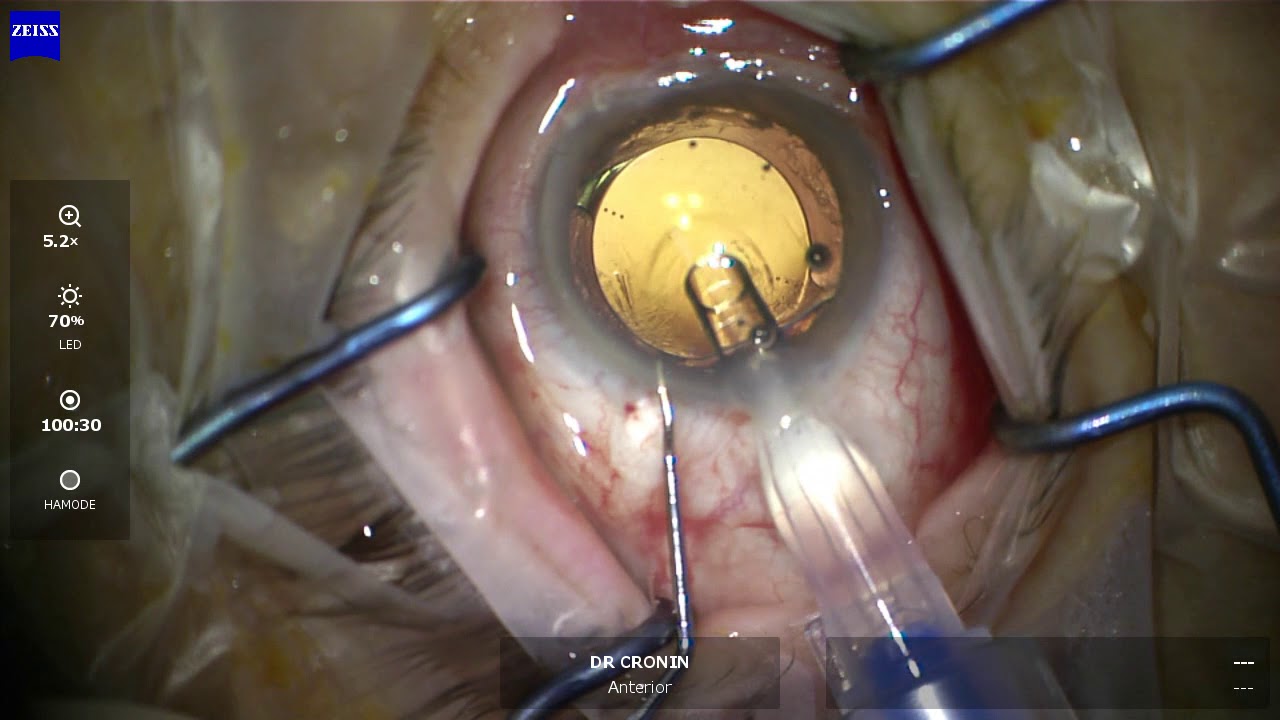
It’s a short day procedure, done with you asleep under sedation and the eye numbed with drops, through a small incision. The lens is folded, injected into the sulcus and positioned; for a toric lens, aligned to the axis marked before surgery. Recovery is similar to routine cataract surgery. I’ve talked through the procedure in this video:
Who it suits, and who it doesn’t
The original lens needs to be stable and well centred, because the secondary lens relies on it, and there needs to be enough room behind the iris for the second lens to sit comfortably. Where those conditions are met, it’s a very good option.
Where they aren’t, I’ll say so. Eyes with an irregular cornea, keratoconus included, need careful assessment before any lens that splits light is considered, whether it’s the first lens or an add-on. And published results with supplementary toric lenses in eyes that have had a corneal transplant are less predictable, with many needing repositioning, so in a grafted eye it’s a considered decision rather than a routine one. As always, the corneal maps and a proper look at the existing lens decide it, not the catalogue.
The bottom line
A secondary lens is a way of fixing leftover focus error, leftover astigmatism, or a wish for near vision without disturbing the lens you already have. The spherical and toric versions solve problems; the multifocal version opens a door, and because it can be closed again, it’s a door worth knowing about. If your cataract surgery left you with vision that’s nearly right but not quite, book a consultation and we’ll work out whether an add-on lens is the fix. The cataract surgery page covers the wider service, and the guide to choosing a lens is the place to start if you haven’t had surgery yet.
Frequently Asked Questions
What is a secondary lens?
A secondary, or add-on, lens is a second intraocular lens placed in front of the one you already have, in the space just behind the iris called the sulcus. Your original lens stays exactly where it is. The secondary lens fine-tunes the result: a spherical version corrects leftover focus error, a toric version corrects astigmatism, and a multifocal version adds near vision.
Can a secondary lens fix astigmatism left after cataract surgery?
Yes. A toric add-on lens is designed for exactly that. In a published series using the AddOn toric lens, residual astigmatism fell from an average of 1.66 dioptres to 0.32 dioptres, with the lens sitting within ten degrees of its intended position in most eyes.
Can a secondary lens fix a dark shadow at the edge of my vision?
Sometimes, yes. That shadow, called negative dysphotopsia, is thought to come from light slipping through the gap between the iris and the edge of the lens implant. A secondary lens placed in front of the original fills that gap. In the published series using the 1stQ AddOn for this problem, six of nine eyes had the shadow resolve completely and one improved. It is not guaranteed, but it is one of the few treatments that reliably helps when the shadow has not settled on its own.
Can I get multifocal vision if I already have a monofocal lens?
Often, yes. A multifocal or trifocal add-on lens layers near and intermediate vision on top of a well-placed monofocal without exchanging it. And because it can be removed, it is the closest thing there is to trying multifocal vision before committing to it.
Is a secondary lens reversible?
Yes, and that is its great strength. It sits in front of the capsule rather than inside it, so removing it is straightforward and leaves the original lens untouched. That is not true of a lens exchange, which depends on the capsule being intact.
Who is not suitable for a secondary lens?
The original lens needs to be stable and well centred, and there needs to be enough room behind the iris for the second lens to sit. Eyes with an irregular cornea need careful assessment, and published results in eyes that have had a corneal transplant are less predictable. Your corneal maps and a look at the existing lens decide it.
