
Astigmatism After Corneal Transplant: Treatment Options

A corneal transplant can give you a perfectly clear cornea and still leave you seeing poorly. The usual reason is astigmatism. The graft is round, it’s stitched into a cornea that heals unevenly, and the result is a surface that’s steeper in one direction than another, sometimes regularly and sometimes in a very irregular way. It’s the most common reason I see people who are disappointed with an otherwise successful graft, and most of them have been told, somewhere along the way, that there’s nothing more to be done.
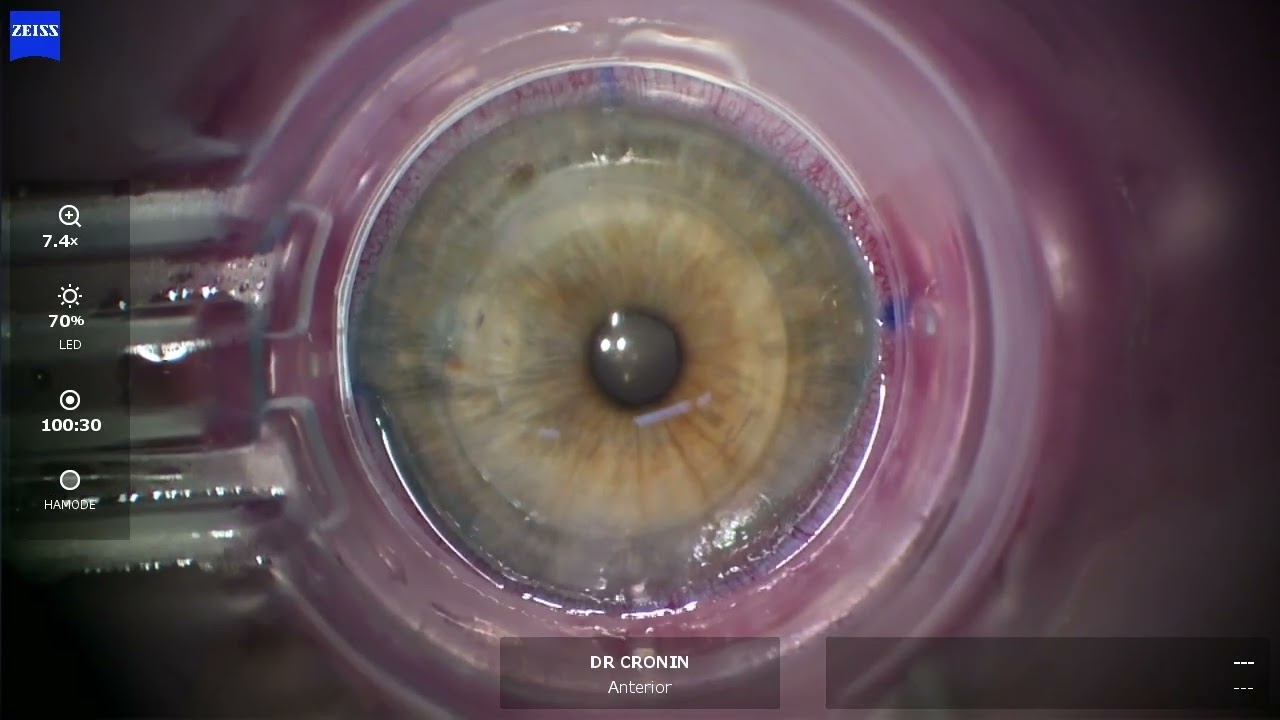
There’s almost always something more to be done. This post goes through the options I use for astigmatism after a penetrating keratoplasty (PK) or a deep anterior lamellar keratoplasty (DALK), from glasses through to resuturing the graft. One of the most useful tools is a femtosecond laser bevelled astigmatic keratotomy, and I’ve explained how it works in this video:
How common is astigmatism after a corneal transplant?
Very common. A small amount is almost universal after a full-thickness graft, and high astigmatism isn’t rare. Reviews put the number of penetrating grafts that end up with more than 5 dioptres of astigmatism at up to about one in five, and a systematic review gives a range of 10% to 31% across studies. To put that in context, most people notice blur from as little as one dioptre.
People often expect a DALK to do much better, because the patient keeps their own inner layer of the cornea. It does have real advantages, but astigmatism isn’t really one of them. When the two operations were compared for keratoconus, a meta-analysis found no significant difference in astigmatism between DALK and PK. Everything in this post applies to both.
Why a graft leaves astigmatism
There are a few reasons, and in most eyes it’s a mix of them:
- The stitches. Tighter sutures steepen the cornea along their direction, so suture tension has a big effect while the stitches are in.
- The wound. The join between the graft and your own cornea heals over many months, and it rarely heals with exactly the same strength all the way round.
- The fit. Any slight mismatch, tilt or offset between the graft and the opening it sits in shows up as astigmatism.
- The host cornea. In people grafted for keratoconus, the rim of their own cornea that’s left can keep thinning slowly over many years, and ongoing keratoconus has been seen under the microscope in tissue removed during later surgery. That’s one reason astigmatism can creep up long after the graft.
The distinction that matters most for treatment is between regular astigmatism, where the cornea is steeper along one axis in a fairly symmetrical way, and irregular astigmatism, where the surface is lumpy and asymmetric. Glasses, soft lenses, keratotomy and toric lens implants work on regular astigmatism. Irregular astigmatism needs something that replaces or reshapes the front surface, like a rigid lens, PTK or a pinhole lens. Corneal topography and tomography tell me which one you’ve got.
Timing, and what happens while the stitches are in
While the sutures are still in, the astigmatism is a moving target, and the first tool is the stitches themselves. Removing or adjusting selected tight sutures can bring a lot of astigmatism down, and that’s usually done in the rooms over the first year or so. The bigger surgical corrections are generally done once the sutures are out and the measurements have settled and stayed stable for a few months. Doing them earlier means correcting something that’s still changing.
Glasses and soft contact lenses
Glasses are the simplest answer, and for low to moderate regular astigmatism they work well. Their limit is the difference between the two eyes. Once the astigmatism or the overall prescription in the grafted eye is much higher than in the other eye, the images become different sizes and shapes, and the brain struggles to combine them. That’s usually the point people stop tolerating glasses.
Soft toric contact lenses get around some of that, because the correction sits on the eye. They’re comfortable and easy, and they suit moderate, regular astigmatism. They can’t correct an irregular surface, because a soft lens just drapes over whatever shape is underneath.
Rigid and scleral contact lenses
For irregular astigmatism, a rigid lens is still the gold standard for sharp vision. It vaults the irregular graft and creates a new, smooth optical surface, and the tear layer underneath fills in the irregularities. Small rigid gas permeable lenses can be hard to fit on a graft because of the step at the edge, so scleral lenses, which sit on the white of the eye and clear the cornea completely, are often the better choice. In one review of 48 grafted eyes fitted with scleral lenses, almost 92% reached 6/12 or better.
The catch is that some people can’t wear them, or don’t want to wear them for the rest of their life. And in a full-thickness graft, anything that inflames the eye can set off a rejection episode, so lens wear needs to be properly reviewed. I’ve written more about where lenses fit and where they don’t in are contact lenses the only treatment for keratoconus?
Astigmatic keratotomy: relaxing the steep axis
Astigmatic keratotomy means placing a pair of curved incisions in the graft, usually just inside the graft-host junction, along the steep axis. Each incision relaxes that axis and lets it flatten, and the flat axis steepens a little to compensate. It’s been used for decades with a diamond blade, but the femtosecond laser has made it far more precise: the depth, length, position and angle of each incision are set exactly, and the laser follows the plan.
The version I use, shown in the video at the top of this post, cuts the incisions on a bevel rather than straight down. A vertical cut can gape open, which makes the effect less predictable and slows healing. A bevelled cut means the two edges overlap, so the wound tends to stay closed while the cornea relaxes. In the original series describing the bevelled technique, astigmatism after penetrating keratoplasty fell from an average of about 9.8 dioptres to about 4.5, with no wound gaping. A review of femtosecond astigmatic keratotomy after keratoplasty found consistent reductions across studies, with the usual caveat that the response varies from eye to eye, and sometimes a second treatment or a suture is needed to fine-tune it.
It’s a short day procedure, with drops for a few weeks afterwards. It works on regular astigmatism, and it suits most people with moderate to high astigmatism in a stable graft.
Wedge excision and resuturing the graft
For the very highest amounts of astigmatism, usually well over 10 dioptres, relaxing the steep axis isn’t enough. Wedge excision does the opposite: it tightens the flat axis. A thin crescent of tissue is removed from the graft-host junction along the flat meridian and the edges are sewn back together, which steepens that axis and evens up the cornea. It’s a bigger operation and the stitches have to be managed again over the following months, but the effect is large. In a series of 22 eyes grafted for keratoconus, astigmatism fell from an average of 11.6 dioptres to 4.9 three years after wedge resection, and a larger series of 51 eyes found almost exactly the same.
In some eyes the better answer is to resuture the graft altogether, particularly where a section of the wound has healed poorly or has stretched. It’s not something I reach for first, but for someone with 15 dioptres of astigmatism and a clear graft, it can turn an unusable eye into a useful one without a regraft.
Topography-guided PTK for irregular astigmatism
When the problem is irregularity rather than plain cylinder, the surface itself has to be smoothed. Topography-guided phototherapeutic keratectomy uses an excimer laser, driven by a map of your cornea, to remove tissue from the high points and leave a more regular surface. I’ve written about how it’s used for corneal scarring, and the same principle applies to an irregular graft. Here’s how I use it for irregular astigmatism:
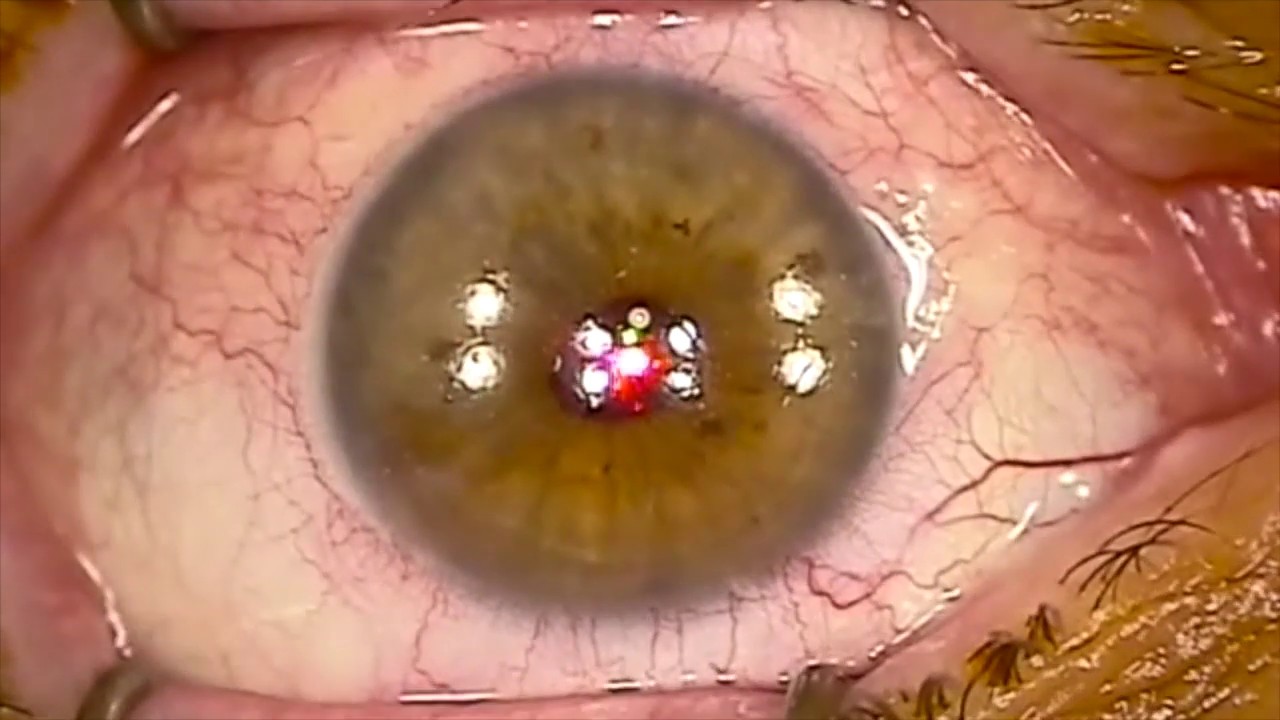
The evidence after grafts is encouraging but comes from small series. In one prospective study of eyes with highly irregular astigmatism after penetrating keratoplasty, topography-guided laser treatment reduced astigmatism from 7.8 to 2.8 dioptres at a year. It needs enough graft thickness to treat safely, and a full-thickness graft can react to any surface treatment with haze or, occasionally, a rejection episode, so it’s planned carefully and followed closely.
Toric lens implants, including high-powered secondary toric lenses
If the astigmatism is reasonably regular and you’re having cataract surgery, or you need it, a toric lens implant can correct it from inside the eye. I correct astigmatism at the time of cataract surgery as a matter of course, and grafted eyes are no exception, with one difference: post-graft astigmatism is often far beyond what stock lenses correct, so the lens may need to be a high-powered toric made to order. In a series of eyes with toric lenses placed after penetrating keratoplasty, the remaining cylinder fell to low levels and vision improved both with and without glasses.
If you’ve already had cataract surgery, a secondary add-on toric lens can sit in front of your existing implant and do the same job without removing it. The honest caveat is that results in grafted eyes are less predictable than in ordinary eyes, and some lenses need to be rotated afterwards. Any surgery inside the eye also puts some stress on the endothelial cells of a full-thickness graft. So the graft has to be healthy and stable before I’d recommend it, and the measurements have to agree with each other.
Pinhole lens implants
For irregular astigmatism that can’t be smoothed out, a small-aperture lens implant is another option. The IC-8 Apthera works like stopping down a camera: a tiny opening in the middle of the lens lets through only the central, well-focused light and blocks the scattered rays coming through the irregular parts of the cornea. I explain how it works here:

In a study of 67 eyes with irregular corneas, corrected vision improved on average from about 6/24 to 6/9 with the IC-8. The trade-off is reduced light and contrast in dim conditions, and some glare. That’s why I generally use it in one eye only, the same approach I take after radial keratotomy.
Which option suits which eye
| Situation | Options I’d usually consider |
|---|---|
| Sutures still in | Selective suture removal or adjustment, glasses |
| Low to moderate regular astigmatism | Glasses, soft toric contact lenses |
| Moderate to high regular astigmatism in a stable graft | Femtosecond bevelled astigmatic keratotomy, toric lens implant |
| Very high astigmatism, often over 10 dioptres | Wedge excision or resuturing, sometimes followed by keratotomy |
| Irregular astigmatism | Rigid or scleral contact lenses, topography-guided PTK, pinhole lens implant |
| Cataract developing as well | High-powered toric or pinhole lens implant at cataract surgery |
These aren’t either-or choices. It’s quite common to combine two steps, for example a wedge resection to bring very high astigmatism down to a manageable level, and then a toric lens or a contact lens to deal with what’s left. A repeat transplant is very rarely needed just for astigmatism in a clear graft.
What’s different after a DALK
The toolbox is the same after a DALK. The main difference works in your favour: because you keep your own endothelium, the inner cell layer, a DALK can’t have the endothelial rejection that threatens a full-thickness graft. That makes contact lens wear and later surgery inside the eye a little less risky for the graft. I’ve written more about the femtosecond laser DALK technique and how the different types of corneal transplant compare.
The bottom line
Astigmatism after a corneal transplant is common, and a clear graft with poor vision is very often a fixable problem rather than a final result. Glasses and soft lenses handle the milder cases, rigid and scleral lenses handle irregular surfaces, and when lenses aren’t the answer there’s femtosecond bevelled astigmatic keratotomy, topography-guided PTK, wedge excision and resuturing, high-powered toric lens implants and pinhole lenses. The right choice depends on whether your astigmatism is regular or irregular, how much there is, whether the stitches are still in, and the state of the rest of the eye. If you’ve been told your graft is clear but you still can’t see well, I’d be happy to look at your maps and talk through the options. Optometrists and ophthalmologists can refer through the referrers page, and there’s more on corneal transplant surgery in Brisbane.
Frequently Asked Questions
Is astigmatism normal after a corneal transplant?
Some astigmatism is almost universal after a penetrating keratoplasty or a DALK, because a round graft is stitched into a cornea that never heals perfectly evenly. In published series somewhere between one in ten and one in three penetrating grafts end up with more than 5 dioptres. A clear graft with high astigmatism is a common problem, and it's usually treatable.
When can astigmatism after a corneal transplant be treated?
Glasses and contact lenses can be used at any stage. While the stitches are still in, selective suture removal or adjustment can reshape the graft. Surgical corrections such as astigmatic keratotomy, PTK, wedge resection or a toric lens implant are usually done once the sutures are out and the measurements have been stable for a few months.
What is a femtosecond bevelled astigmatic keratotomy?
It's a pair of curved relaxing incisions placed in the graft along the steep axis with a femtosecond laser, which flattens that axis and reduces the astigmatism. The incisions are cut at an angle rather than straight down, so the edges overlap and seal, which reduces the gaping that can happen with vertical cuts. It's done as a short day procedure.
Can I wear contact lenses after a corneal transplant?
Yes. Rigid and scleral contact lenses are often the best way to see after a graft with irregular astigmatism, because they create a new smooth optical surface. Soft toric lenses can work for moderate, regular astigmatism. Lens wear in a grafted eye needs regular review, since anything that inflames the eye can trigger a rejection episode in a full-thickness graft.
Can a toric lens implant fix astigmatism after a corneal transplant?
Often, if the astigmatism is reasonably regular and the graft is stable. A toric lens can be placed at the time of cataract surgery, or as a secondary add-on lens in front of an existing implant. Toric lenses can be made to order in much higher powers than standard lenses. Results after a graft are less predictable than in an ordinary eye, so the planning has to be careful.
Will I need another corneal transplant to fix the astigmatism?
Very rarely. A repeat graft is reserved for a graft that has failed or scarred, or where every other option has been tried. Most patients with high astigmatism after a clear graft can be helped with lenses, keratotomy, PTK, a lens implant or, for the highest amounts, wedge excision and resuturing.
Is astigmatism different after DALK compared with PK?
Not much. Meta-analyses comparing the two in keratoconus have found similar amounts of astigmatism, and the same treatments are used for both. The main difference is that a DALK keeps your own inner layer of the cornea, so it can't have endothelial rejection, which makes contact lens wear and later eye surgery a little less risky for the graft.
