
Can a Distorted Pupil Be Repaired? Pupilloplasty Explained

The pupil is the aperture of the eye. It lets in the light the retina needs and keeps out the rest. When it’s abnormal, whether the wrong shape, stuck wide open or missing altogether, light that should’ve been blocked gets in anyway and scatters across the retina. What people tell me about is glare, a dislike of bright light, sometimes a ghost image, and an eye that looks different from the other one. Plenty of them have been told along the way that nothing can be done, and in my experience that’s usually wrong. This post is about the two tools I use to fix a damaged pupil: a suturing technique called four-throw pupilloplasty and, for eyes with too little iris left to repair, a custom-painted artificial iris.
Why a damaged pupil matters
The iris is the coloured curtain and the pupil is the hole in it. A healthy pupil is round, sits in the centre and changes size with the light. When part of the curtain is torn or was never there, a few things tend to go wrong together:
- Glare and light sensitivity. Light gets in through the edge of the lens, where the optics are worst, and scatters across the retina. Sunlight, oncoming headlights and screens all become harder to put up with.
- Ghost images. If there’s a second, off-centre opening in the iris, it can throw a faint second image. Patients usually describe it to me as a shadow or a doubled edge in the one eye.
- Appearance. A keyhole pupil, an oval one or one big black pupil gets noticed by other people, and I hear about that more than you’d expect.
- Later surgery. An eye with a poor iris is harder to operate on. The edge of a lens implant can end up visible through the gap, and some lens designs I can’t use at all.
What damages a pupil
Coloboma
A coloboma is a gap the eye is born with. Early in pregnancy the developing eye is a little cup with a seam running along its lower inner side, and that seam is supposed to close over. When it doesn’t close all the way, the iris ends up with a wedge missing at the lower, inner part of the pupil, and that’s what gives the classic keyhole shape. The rest of the iris is usually normal, which is exactly what makes a coloboma a good candidate for repair. Some colobomas also involve the retina or the optic nerve at the back of the eye. I can’t suture those parts, obviously, but the iris component can still be closed, and closing it still cuts down the glare.
Trauma
A blunt injury, whether from a ball, a fist, a cork or an airbag, can tear the sphincter, which is the small ring of muscle that constricts the pupil. The pupil is left permanently large and often oval. We call that traumatic mydriasis. A harder blow can tear the iris away from its root, so you get a second opening out at the edge of the iris. Penetrating injuries and previous surgery can take iris away altogether. The iris has almost no ability to heal itself, so these defects are permanent unless somebody repairs them.
Iris tumours
An iris melanoma, or another lesion on the iris, is sometimes treated by cutting out the wedge of iris it’s sitting in. That deals with the tumour, but a sector of iris goes with it, and the patient is left with a large, irregular pupil and all the glare that comes with one.
Aniridia
Aniridia means the iris is essentially absent. It’s usually there from birth and usually affects both eyes, although there’s often a small rim of iris tissue left. You can also get near-total loss of iris after severe trauma. In these eyes there’s simply nothing to sew to, so a different approach is needed.
Four-throw pupilloplasty: sewing the pupil back into shape
Pupilloplasty just means reshaping the pupil with sutures placed inside the eye. Surgeons have been tying knots inside the eye for decades, but the technique I use is the single-pass four-throw method, which was described by Priya Narang and Amar Agarwal in 2017. Working through tiny incisions, I pick up the two edges of the iris defect with a single pass of a needle. The end of the suture then gets passed through its own loop four times, which forms a small helical knot that slides into the eye and locks itself as it tightens. There’s no second pass and no bulky knot left sitting in the eye, and the ends get trimmed flush. In their original series of 27 eyes, not a single knot loosened over six months of follow-up, and none of those eyes developed inflammation from the suture.
The reason I like it is that one reliable stitch lets me repair a lot of quite different pupil problems:
- closing a coloboma so the pupil comes out round
- shrinking a pupil that’s been stuck wide since an injury, with a series of sutures around the rim
- reshaping an oval or peaked pupil that’s been left behind by earlier surgery
- centring the pupil over a lens implant so the implant’s edge is hidden
- covering the edge of a lens implant that’s become visible through a gap
An iris that’s been torn from its root gets repaired a little differently, by stitching it back to the wall of the eye, and I’d usually do that at the same operation. The four-throw stitch has turned out to have uses beyond appearance and glare as well. It’s used to pull the iris away from the drainage angle in some forms of angle-closure glaucoma, and to make the pupil smaller before a corneal transplant, because a small, intact pupil holds the air bubble that keeps a new endothelial graft pressed in place. I’ve talked through the technique in this video:

When there isn’t enough iris to repair: the artificial iris
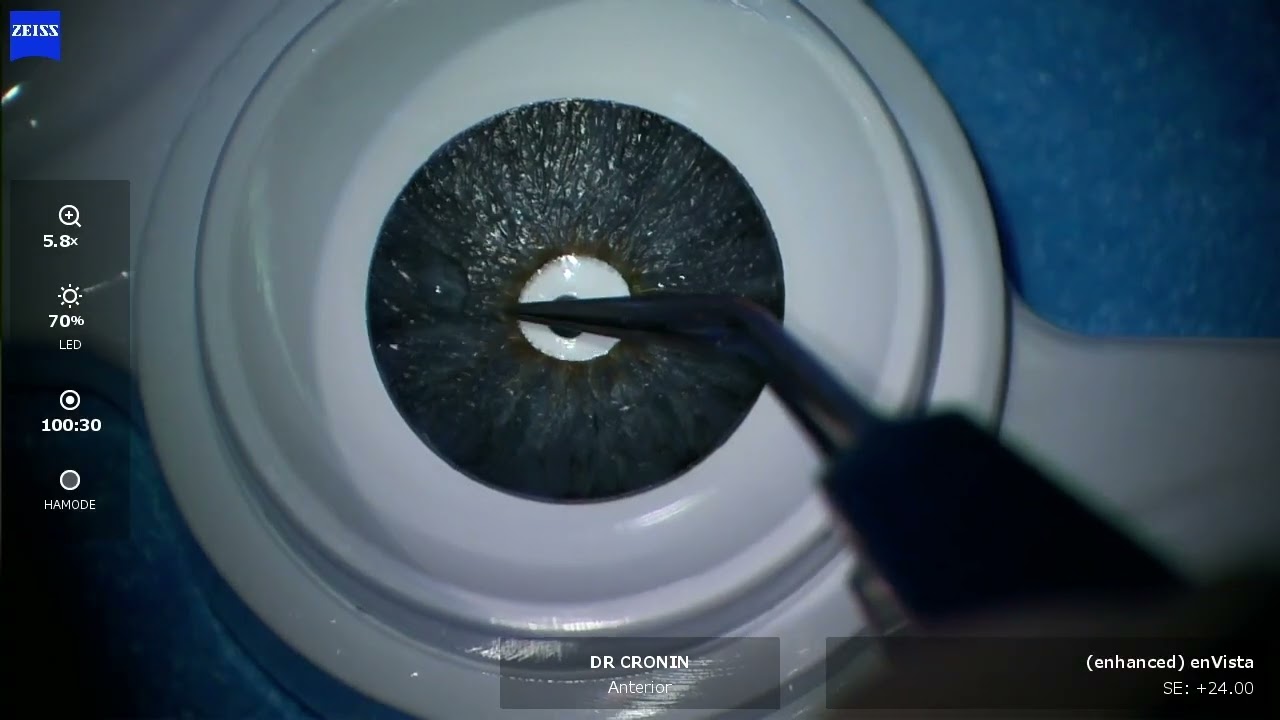
Suturing only works if there’s iris on both sides of the gap to bring together. When the missing area is too big, or there’s no iris there at all, I use the CustomFlex ArtificialIris, which is made by HumanOptics in Erlangen, Germany. It’s a thin, flexible disc of medical-grade silicone with a fixed central pupil, and every one is made to order. I send them a clinical photograph of your other eye, and the front surface of the implant is hand painted to match it, the colour, the pattern and the fine radial lines. What I’m after is two eyes that look like a pair. If both eyes are affected, we choose the colour from a sample photograph instead.
Because the implant folds, it goes in through a small incision, unrolls inside the eye and gets trimmed to size. It can go in alongside a lens implant during cataract surgery, or, in a version that’s reinforced with a fine fibre mesh, it can be sutured to whatever iris remains or to the wall of the eye when there’s nothing else to hold it. And where only a wedge of iris is missing, I can cut a matching segment from the disc rather than replacing the whole iris.
In 2018 the US Food and Drug Administration approved it as the first stand-alone artificial iris in the United States, for congenital aniridia and for iris defects caused by albinism, trauma or surgical removal. That approval was based on a study showing less light sensitivity and glare and a better appearance of the eye. Those indications cover most of the patients I use it for: people with aniridia from birth, eyes where an injury has destroyed most of the iris, and eyes where a sector of iris was removed to treat a melanoma or another iris lesion. HumanOptics are clear that it’s a medical prosthesis and don’t supply it for changing the colour of a healthy eye, and I take the same view. Here’s a closer look at the implant itself:
Which repair suits which eye
It really comes down to how much healthy iris you’ve got left:
- Enough iris on both sides of the defect: four-throw pupilloplasty. That covers most colobomas, most traumatic pupils and most of the distortions left by earlier surgery.
- A large sector missing, or almost no iris: the artificial iris, either as a segment or as the full disc.
- A bit of both: sutures to gather up what’s there, and a prosthesis for the rest.
Injuries that damage the iris have often damaged the lens as well, and the artificial iris is designed to go in alongside a lens implant, so quite often I’ll do the pupil repair as part of cataract surgery or a lens exchange rather than as a separate operation. That way you get one anaesthetic and one recovery.
What the surgery is like
It’s a day procedure, done through the same small incisions I use for cataract surgery. Most of my patients are asleep under sedation with the eye numbed by drops, which is the same arrangement I use for lens surgery. Afterwards you’ll be on drops for a few weeks, and I’ll see you a handful of times to check the pressure inside the eye, because any surgery on the iris can push the pressure up for a while.
There are two things I make sure people understand beforehand, and I say them to every patient. The first is that a repaired pupil is fixed in size. A sutured pupil and an artificial iris both lose the ability to open and close with the light, and that’s the price you pay for getting rid of the glare. I choose a size that blocks stray light but still lets me examine your retina. The second is what we’re aiming for, which is an eye that looks natural at conversational distance. It won’t be perfectly symmetrical under a microscope, and it doesn’t need to be. People who go in with those expectations are consistently pleased, in my experience.
The bottom line
If your pupil has been misshapen since birth, torn by an injury or left with a gap after tumour surgery, you don’t have to just live with it. The four-throw technique means most of these defects can be repaired with a few small stitches, and where there isn’t enough iris left, a hand-painted artificial iris can take its place and be matched to your other eye. If you’ve been told that the glare from a damaged pupil is permanent, I’d say it’s worth a proper assessment.
Frequently Asked Questions
Can an abnormal pupil be fixed?
Usually, yes. Whether the pupil has been abnormal since birth (a coloboma or aniridia), or was left misshapen by an injury or earlier surgery, it can usually be repaired: either by reshaping it with fine internal sutures (pupilloplasty) or, when too little iris remains, with a custom-made artificial iris painted to match your other eye.
What is pupilloplasty?
Pupilloplasty is surgery that reshapes the pupil using fine sutures placed inside the eye through tiny incisions. The edges of a gap or tear in the iris are drawn together so the pupil ends up round, central and a sensible size. The technique I use is the single-pass four-throw method, which forms a small self-locking knot from one pass of the needle.
Can an iris coloboma be repaired?
In most cases, yes. A coloboma is a wedge of iris that never formed before birth, usually at the lower inner part of the pupil, giving the classic keyhole shape. The rest of the iris is normally healthy, so the two edges of the gap can be sutured together to give a round pupil and much less glare.
My pupil has been large and misshapen since an injury. Can it be fixed?
Usually, yes. A blunt injury tears the small muscle that constricts the pupil, leaving it permanently wide and often oval. Sutures placed around the pupil margin can bring it back down to a normal size and shape. If the iris has also been torn from its root, that tear can be stitched back to the wall of the eye at the same operation.
What is an artificial iris?
An artificial iris is a thin, flexible disc of medical-grade silicone with a fixed central pupil, used when there is too little iris to repair with sutures. The one I use is the CustomFlex ArtificialIris made by HumanOptics in Germany. It is folded, placed through a small incision and unrolled inside the eye, where it can sit with a lens implant or be sutured in place.
Will the artificial iris match my other eye?
That is the whole point of it. Each one is made to order and hand painted to match a clinical photograph of your other eye, including the colour and the fine pattern of the iris. If both eyes are affected, the colour is chosen from a sample photograph. The aim is a natural pair of eyes at conversational distance rather than a perfect match under a microscope.
Can a pupil repair be done at the same time as cataract surgery?
Yes, and it often is. Injuries that damage the iris frequently damage the lens as well, and an artificial iris is designed to be implanted together with a lens implant. Combining the two means one operation and one recovery.
Will my repaired pupil still react to light?
No, or only a little. A sutured pupil and an artificial iris are both fixed in size, which is the trade-off for getting rid of the glare. I choose a size that keeps light out but still lets your retina be examined, and most patients find the loss of a reactive pupil unnoticeable next to the improvement in glare.
