
Salzmann's Nodules: Treatment with Superficial Keratectomy

If you’ve been told you have Salzmann’s nodules (or Salzmann’s nodular degeneration, to give it its formal name), here is the first thing to know: they are completely benign. These little bumps on the cornea are not a growth to fear, and when they do start causing trouble, removing them is about as gentle as eye surgery gets.
What are Salzmann’s nodules?
Salzmann’s nodules are smooth, raised, bluish-grey or white mounds of scar-like tissue that form on the surface of the cornea, the clear window at the front of the eye. They usually develop slowly over years, often sitting quietly out towards the edge of the cornea where you’d never know they were there.
The condition goes by several names: Salzmann’s nodular degeneration, Salzmann nodular corneal degeneration, Salzmann’s corneal degeneration, or sometimes, incorrectly, “Salzmann’s dystrophy” (it isn’t an inherited dystrophy, which is good news). Whichever name is on your referral letter, it’s the same benign condition.
Many are found by chance during a routine eye exam. But as they grow or creep towards the centre, they can cause a gritty, foreign-body feeling, irritation in the wind or air-conditioning, and blurred vision — because a bump on the cornea warps its shape and creates irregular astigmatism that glasses can’t fully correct.
What causes Salzmann’s nodular degeneration, and why mostly women?
The honest answer is that we don’t completely understand the cause. What we do know is that most nodules grow on corneas that have been irritated for a long time: chronic dry eye or blepharitis (inflammation of the eyelid margins), years of contact lens wear, previous eye surgery or old episodes of inflammation can all set the stage. In some patients they appear with no obvious trigger at all.
Salzmann’s nodules are also far more common in women, typically in middle age or later. Hormonal influences on the ocular surface are suspected to play a part, but the full story is still being worked out. If that’s you, nothing you did brought them on.
Superficial keratectomy: the main treatment
When nodules are small and quiet, they can simply be watched, with lubricating drops to keep the surface comfortable. But once they cause persistent irritation or affect your vision, the treatment of choice is superficial keratectomy. It is far less dramatic than it sounds.
Salzmann’s nodules sit on the cornea rather than in it, separated from the deeper tissue by a natural plane of separation. That means they can usually be peeled away cleanly, a little like lifting a sticker off glass, leaving the healthy cornea beneath untouched. There is no cutting into the eye and no stitches, and with anaesthetic drops the procedure itself is painless — most patients are surprised it’s already over.
And you don’t have to be awake for it. Numbing drops alone are enough for many patients, but if you’d rather know nothing about it, superficial keratectomy can be done with you heavily sedated, effectively asleep, with a specialist anaesthetist looking after you throughout.
You can watch me remove Salzmann’s nodules in this short video:

Afterwards, a soft bandage contact lens protects the eye while the surface skin layer heals. Most eyes feel a little gritty for the first day or two, then settle quickly as the surface heals under the bandage lens. The cornea regains its smooth shape, and vision typically improves as the irregular astigmatism settles.
One situation where removal really matters: before cataract surgery. Nodules distort the corneal measurements used to calculate your lens implant, so I remove them first, let the surface settle, and re-measure, so your cataract surgery can be planned with accurate numbers rather than estimates.
Before and after: what removal does to the cornea, on a map
The best way to see what a Salzmann’s nodule does to vision is corneal topography: a colour-coded map of the cornea’s curvature, measured point by point. Warm colours (yellow, orange, red) are steeper areas; cool colours (green, blue) are flatter ones. A healthy cornea maps as a smooth, regular pattern; sharp patches of blue sitting inside that pattern mean the surface has been dragged out of shape.
Here is a real example from my clinic: the same eye, mapped before and after superficial keratectomy.
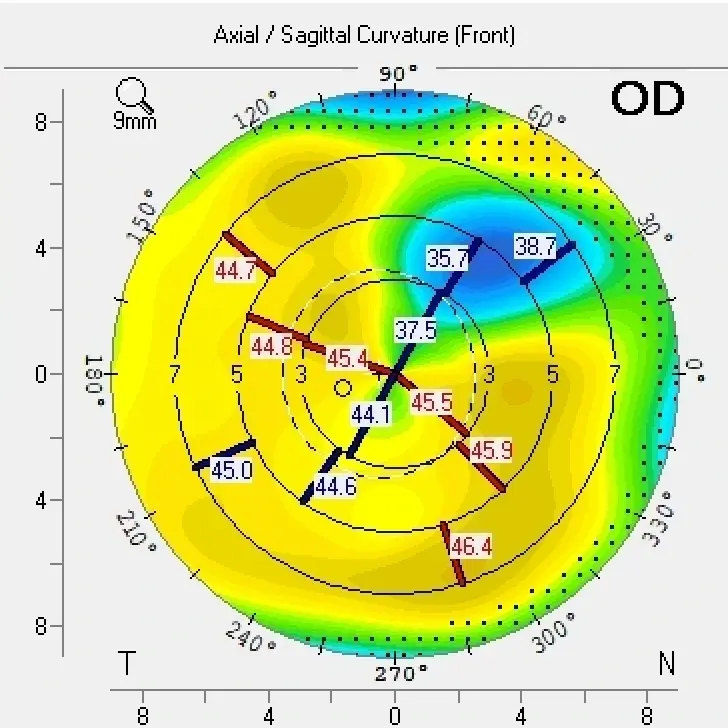
Before: the deep blue patch towards the top of the map is the nodule’s footprint. Where the surrounding cornea measures in the mid-40s (dioptres), the surface over the nodule reads around 36 to 38 — nearly ten dioptres of focal flattening, with distortion radiating well beyond the nodule itself. A cornea this irregular scatters light unevenly, and no pair of glasses can fully focus through it.
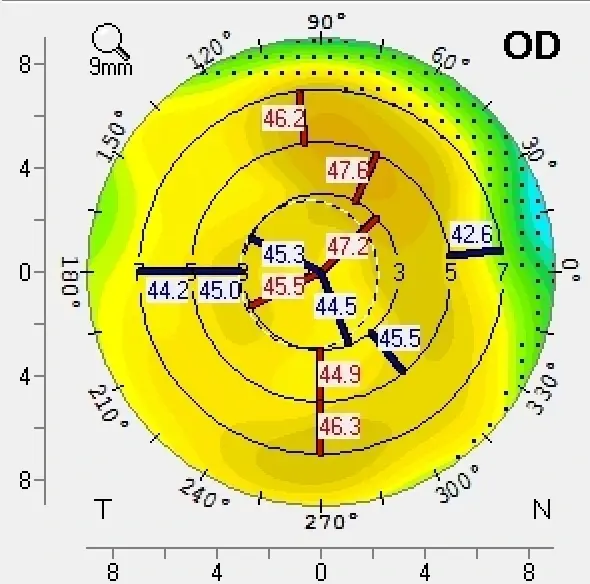
After: the blue patch is gone. With the nodule peeled away, the surface has returned to a smooth, regular map with consistent values across the cornea. And this is the point of the exercise: as the topography improves, so does the vision, because a regular cornea focuses light cleanly and lets glasses or contact lenses do their job properly. It is also why removing nodules before cataract surgery matters so much — the “after” map is the one you want your lens calculations based on.
Where does PTK fit in?
For some patients I add a phototherapeutic keratectomy (PTK) — an excimer laser polish of the corneal surface — after the nodules are peeled. PTK is useful when the surface underneath is left slightly uneven, when nodules have recurred before, or when fine scarring needs smoothing to get the best optical result. It’s the same laser family we use for vision correction, used here purely to restore a perfectly smooth surface. You can read more in my article on topography-guided PTK for corneal scarring.
Gritty eyes or blurring vision? Get them looked at
Salzmann’s nodules are benign, slow and very treatable. If yours have started to irritate or blur, a quick corneal assessment will show whether a simple superficial keratectomy could make your eyes comfortable and clear again.
Frequently Asked Questions
Are Salzmann's nodules cancerous?
No. Salzmann's nodules, the hallmark of Salzmann's nodular degeneration, are completely benign. They are small mounds of scar-like tissue that build up on the surface of the cornea, usually very slowly, and they never turn into cancer. They only need treatment if they cause irritation or start to affect your vision.
Does superficial keratectomy hurt?
The procedure itself doesn't hurt: the eye is numbed with anaesthetic drops, and most patients feel nothing more than a light touch. It is normal for the eye to feel gritty and watery for a day or two afterwards while the surface heals; a bandage contact lens and lubricating drops keep most patients comfortable.
Can I be asleep for Salzmann's nodule removal?
Yes. Superficial keratectomy is usually done with numbing drops alone, but patients who would rather not be aware of the procedure can have it under deep sedation with a specialist anaesthetist: you drift off before it starts and wake with it finished, usually with no memory of the procedure. It remains a day procedure either way.
Can Salzmann's nodules come back after removal?
They can, although many patients never see them again. Keeping the ocular surface healthy reduces the chance of recurrence, and if a nodule does return it can usually be removed the same way, or polished with a phototherapeutic keratectomy (PTK) laser.
Why do I need my Salzmann's nodules removed before cataract surgery?
Nodules distort the shape of the cornea, which throws out the measurements used to choose your lens implant. Removing them first, then letting the surface settle and re-measuring, means your cataract surgery can be planned with accurate numbers and a better visual result.
