
Can Laser Eye Surgery Fix Astigmatism? Yes, Very Accurately

Yes. Astigmatism is one of the things laser eye surgery corrects best, and with today’s technology it’s corrected very accurately, with results that last. Here’s how, in a few minutes’ reading.
What astigmatism is
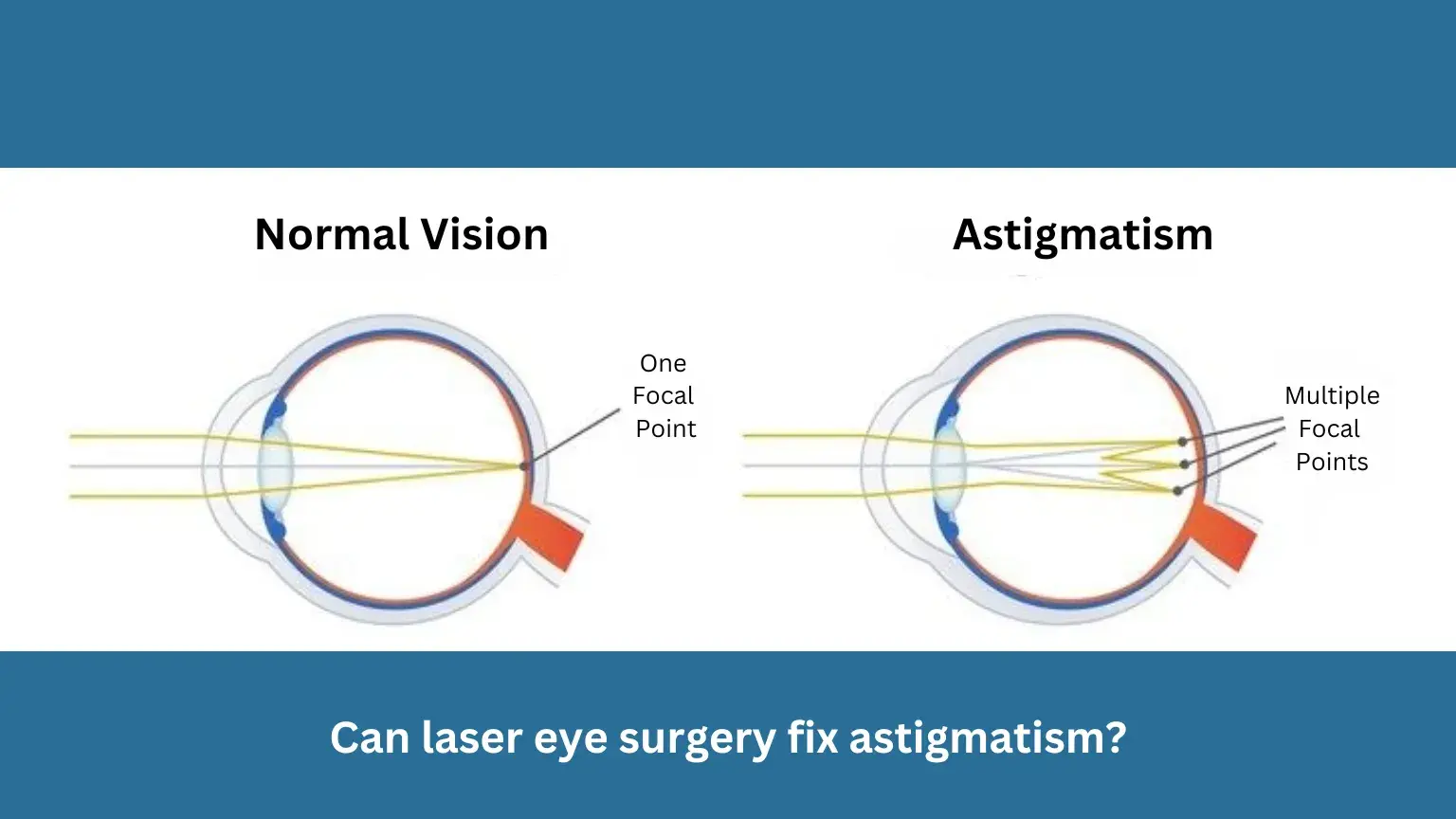
A normal cornea is curved like a football cut in half: the same in every direction. An astigmatic cornea is curved more steeply in one direction than the other, like the back of a spoon. Light entering it focuses at two points instead of one, and you see blur, ghosting or smeared edges, especially at night. Glasses and contact lenses correct the blur by bending light to compensate. They don’t change the cornea.
How the laser fixes it
Laser eye surgery removes a precisely calculated, microscopically thin layer of corneal tissue, more along the steep axis than the flat one, until the curve is the same in every direction. The cause of the astigmatism is gone, not compensated for. LASIK and PRK both do this with the same laser; the difference between them is how the surface is handled, not how well the astigmatism is treated.
Why ray tracing makes it so accurate
The hard part of treating astigmatism has never been the laser. It’s knowing exactly how much to treat and on exactly which axis. Traditional planning starts with the glasses test, “which is better, one or two?”, which is subjective and has a margin of error built in.
WaveLight Plus ray tracing removes that step. A single scan measures your whole eye, front and back surface of the cornea, the lens and the length of the eye, and builds a three-dimensional virtual model of it. The treatment is then calculated by tracing light rays through that model until they focus perfectly, and applied to the cornea exactly as calculated. Nothing depends on how you answered at the phoropter.
The evidence backs it up. In a randomised, double-blinded trial published in the journal Ophthalmology in 2025, patients had one eye treated with WaveLight Plus and the other with standard wavefront-optimised LASIK. Every WaveLight Plus eye saw 20/20 or better without glasses, against 93% of the standard eyes, and 83% saw 20/16 or better, against 73%. Refractive accuracy was slightly higher too.
I perform ray-tracing-guided LASIK at Focus Vision, which has the only WaveLight Plus system in Queensland.
Do the results last?
Yes. In a two-year series of eyes treated with WaveLight Plus ray tracing, every eye saw 20/20 or better without glasses at two years, none lost a line of best vision and 65% gained one, 95% were within half a dioptre of the target and about 85% had half a dioptre or less of astigmatism remaining. The cornea doesn’t drift back. Your eyes still age, and reading glasses arrive in your forties for everyone, but the astigmatism correction holds.
Who it suits
Most people with astigmatism and a stable prescription are candidates. Three things decide it, and all three come from the scans at your assessment rather than from the astigmatism itself:
- A healthy, strong cornea. I measure corneal strength directly, with Corvis biomechanics and the TBI score, and won’t do laser on a cornea that can’t take it.
- Regular astigmatism. Irregular astigmatism from keratoconus is a different condition. It’s treated with cross-linking and CAIRS, not laser, and it’s most of what I do.
- A prescription in range. Very high prescriptions are better served by an implantable lens or refractive lens exchange, which correct astigmatism just as well. And if a cataract is developing, the astigmatism is corrected as part of cataract surgery rather than with laser.
The assessment at Focus Vision is free, takes about an hour, and tells you which of these applies to you. Costs are the same whether or not you have astigmatism. If you’d rather start online, the suitability test takes two minutes.
Frequently Asked Questions
Can laser eye surgery fix astigmatism?
Yes. Astigmatism is one of the things laser eye surgery corrects best. The laser reshapes the uneven curve of the cornea into a regular one, which removes the cause of the blur rather than compensating for it the way glasses do.
How accurate is laser eye surgery for astigmatism?
Very. With WaveLight Plus ray tracing, the treatment is calculated from a three-dimensional model of your own eye rather than from a subjective glasses test. In a randomised head-to-head trial, every eye treated this way saw 20/20 or better without glasses, and in a two-year series about 85% of eyes had half a dioptre of astigmatism or less remaining.
Will my astigmatism come back after laser eye surgery?
The correction is permanent, because the cornea has been reshaped. In the two-year WaveLight Plus series, 95% of eyes were still within half a dioptre of the target. Your eyes still age normally, so reading glasses arrive in your forties as they do for everyone, but the astigmatism itself does not return.
Is LASIK or PRK better for astigmatism?
Both correct astigmatism with the same laser and the same accuracy. The choice depends on your cornea, your prescription and your lifestyle, and it is made from your scans at the assessment rather than from the astigmatism itself.
What if my astigmatism is too high or irregular for laser?
Very high prescriptions can be treated with an implantable lens or refractive lens exchange instead. Irregular astigmatism from keratoconus is a different condition and needs a corneal specialist rather than laser, which is exactly what I do.
