
Do You Need to Travel Overseas for C3-R Cross-Linking?

Every few weeks I see a keratoconus patient, or a parent of one, who has been reading about C3-R and is weighing up a trip to Beverly Hills. They’ve worked out that it’s the gentler, epithelium-on version of cross-linking, the kind that doesn’t scrape the surface of the eye, and they’ve come away thinking that means going overseas.
Their instinct about epi-on is a good one. The trip is the part I’d push back on. The same category of treatment, in a more advanced form with FDA Phase 3 evidence and a larger published dataset behind it, is available in Brisbane with a Medicare rebate, and patients travel here for it from all over Australia and from overseas. I’ll go through the evidence so you can judge for yourself.
What C3-R actually is
C3-R, marketed as Holcomb C3-R, is the brand name for the transepithelial riboflavin cross-linking that Dr Brian Boxer Wachler developed in Beverly Hills in 2003 and offers exclusively at his institute. I can see why it appeals. In the original cross-linking method we remove the epithelium, the cornea’s thin surface skin, so the riboflavin can soak into the tissue underneath. It works, but that raw surface is why the first few days hurt and recovery is slower. Epi-on cross-linking leaves the surface where it is.
Those advantages are real, and I say this to everyone who asks: they come with epi-on cross-linking generally, whichever brand name is on it. A 2021 systematic review pooling the published comparisons found epi-on carried less risk of delayed healing and persistent haze than epi-off, with less pain and fewer surface complications.
Why the early epi-on methods fell short, and what fixed it
The same review found the catch. At twelve months, 7% of eyes treated with the older epi-on methods had progressed, compared with 2% after epi-off. The reason, as I explain it in clinic, is chemistry. Cross-linking relies on ultraviolet light activating riboflavin in the presence of oxygen, and an intact epithelium gets in the way of both. So the early transepithelial protocols were delivering a weaker treatment.
What fixed it was engineering: a riboflavin formulation that gets across the epithelium, supplemental oxygen through goggles during the treatment, and higher-intensity pulsed ultraviolet light so oxygen can replenish between pulses. That’s the approach the US Food and Drug Administration looked at in Glaukos Epioxa. In its Phase 3 trials the treatment met its primary endpoint, flattening the steepest part of the cornea by 1.0 dioptre relative to untreated control eyes, and on 20 October 2025 the FDA approved Epioxa as the first incision-free cross-linking treatment, for patients aged thirteen and over. I was the first surgeon in Australia to perform it, back when Avedro still called it Boost, and I’ve been offering it in Brisbane for years. There’s more on the Epioxa story elsewhere on this site.
Aiming the treatment at the cone
Going epi-on sorted out the recovery problem. Topography guidance, which most people haven’t read about, is aimed at the disease itself.
Standard cross-linking, whether it’s epi-on or epi-off, treats the whole cornea with one broad beam of ultraviolet light. But keratoconus doesn’t affect the whole cornea evenly. It’s a cone, a localised patch of weakness and steepening, usually below the centre. Topography-guided cross-linking uses your corneal map to concentrate the ultraviolet energy on that cone, so more of the stiffening goes where the cornea is weakest and less where it’s healthy.
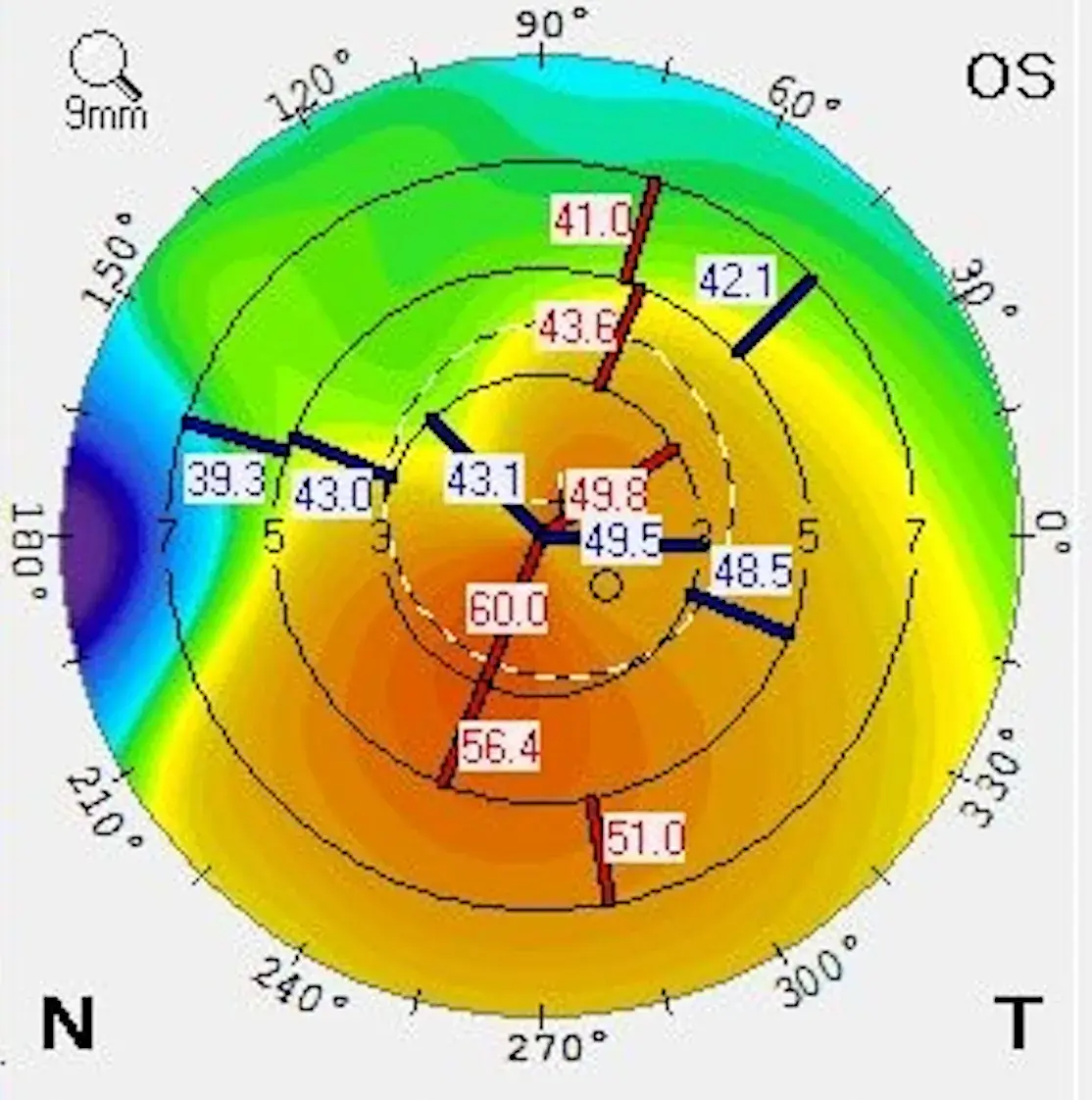
I do this on the Glaukos Mosaic system. I was one of fourteen surgeons worldwide given early access to the platform, and it’s still the only topography-guided cross-linking machine in Australia. There’s independent published evidence too: a prospective series of 42 eyes treated with epi-on, oxygen-supplemented, customised cross-linking reported better uncorrected and corrected vision and significant corneal flattening at one year, with no adverse events.
What our own published data shows
The results of my technique, which combines Mosaic topography-guided treatment with oxygen goggles and pulsed epi-on irradiation, are published in the Journal of Cataract and Refractive Surgery (Cronin, Gunn and Chang, 2024). It’s the largest dataset of this procedure published anywhere in the world: 102 eyes of 80 patients followed for about a year.
The numbers are worth a slow read, because standard cross-linking was never designed to do this:
- Kmax, the steepest point of the cornea and the standard measure of keratoconus progression, went from 53.0 dioptres to 51.9. Normally cross-linking’s job is just to stop that number going up. Here it came down by more than a dioptre on average.
- Mean corneal curvature fell from 46.2 to 45.8 dioptres.
- Best corrected vision improved from 0.18 to 0.07 logMAR on average, roughly a line on the chart, and 60% of patients could see better with their glasses or lenses after treatment than before.
We go into cross-linking hoping for stability, so flattening and better vision on top of that is a different kind of outcome, and I put it down to the customised pattern.
How that compares with what C3-R has published
I want to be fair here, because C3-R has been around a long time and its clinic reports excellent results. So I’ll stick to what’s in the peer-reviewed literature.
The published record for C3-R that I can find comes down to two items. There’s a 2007 retrospective series in the Journal of Cataract and Refractive Surgery comparing 12 eyes treated with Intacs ring segments alone against 13 eyes treated with Intacs plus C3-R, which found that adding C3-R enhanced the effect of the rings, and a 2010 letter in the same journal arguing that the transepithelial technique is effective. The clinic’s website quotes a 99.3% stability figure, which I haven’t been able to find in a peer-reviewed publication.
What stands behind the treatment in Brisbane is a multicentre FDA Phase 3 programme for the epi-on oxygen-enhanced method, an independent 42-eye prospective series for the customised version, and our own 102-eye series in the same journal, which reported flattening and better vision as well as stability. I’d add that none of this means C3-R doesn’t work. The evidence for what we do here is simply larger and more recent, it has been independently replicated, and it reports better outcomes than anything C3-R has published.
Patients come to Brisbane for this
Which brings me back to the trip. In my experience the travel goes the other way. Patients come to us for this treatment from every part of Australia and from overseas, because the combination of oxygen-enhanced epi-on treatment and topography guidance on the Mosaic isn’t offered anywhere else in the country as far as I’m aware. It’s a day procedure. Most interstate patients fly in, have their assessment and treatment, and are home within the week, and we plan the follow-up scans around their travel. The travelling to see Dr Cronin page covers clinics, timelines and the travel subsidies that may apply.
So if you’ve been told your keratoconus is progressing and you’ve been reading up on C3-R, you’ve been looking in the right direction. You don’t have to leave the country to get it, and what we offer here is a more advanced version of the same idea. If you’d like to talk it through, book a consultation below.
Frequently Asked Questions
What is C3-R cross-linking?
C3-R, marketed as Holcomb C3-R, is the brand name for the epithelium-on (epi-on) riboflavin cross-linking developed by Dr Brian Boxer Wachler in Beverly Hills in 2003. It is offered only at his institute. The idea behind it, strengthening the cornea without scraping off its surface layer, is the same idea behind all epi-on cross-linking, including the treatment I perform in Brisbane.
Is C3-R available in Australia?
No. The brand is exclusive to one clinic in the United States. What is available in Australia is epi-on cross-linking in a more advanced form: oxygen-enhanced, topography-guided treatment on the Glaukos Mosaic system, which as far as I know is offered nowhere else in the country. It has FDA Phase 3 evidence behind it and a published Brisbane series of over 100 eyes.
Is epi-on cross-linking as effective as the epi-off version?
Early epi-on methods were weaker, because riboflavin and oxygen struggle to get through an intact epithelium, and pooled studies showed more eyes progressing after older epi-on treatment than after epi-off. Modern oxygen-supplemented, high-fluence epi-on was designed to fix that. The FDA Phase 3 trials of Epioxa met their primary endpoint, and in my own published series the cornea flattened by about a dioptre on average rather than merely holding still.
What does topography-guided cross-linking add?
Standard cross-linking treats the whole cornea with one broad beam. Topography-guided treatment uses your corneal map to concentrate the ultraviolet energy on the cone, where the cornea is weakest and steepest. In my published series, 60% of patients improved their best corrected vision, which standard cross-linking is not designed to do.
Do I get a Medicare rebate for cross-linking?
Yes. In Australia, cross-linking for progressive keratoconus attracts a Medicare rebate whether it is done in a day hospital or in our outpatient procedure room at the Queensland Eye Institute. Surgery performed overseas attracts no Medicare rebate at all, and the travel costs come on top.
I live interstate or overseas. How does treatment in Brisbane work?
Many of my keratoconus patients travel to Brisbane for cross-linking, from every part of Australia and from overseas. It is a day procedure with a recovery measured in days, so most people fly in, have their assessment and treatment, and fly home within the week. We plan the follow-up scans around your travel. There is a guide to clinics, timelines and travel subsidies on the travelling to see Dr Cronin page.
